|
Doxygen
1.9.8
Toolkit for Adaptive Stochastic Modeling and Non-Intrusive ApproximatioN: Tasmanian v8.2

|
|
Doxygen
1.9.8
Toolkit for Adaptive Stochastic Modeling and Non-Intrusive ApproximatioN: Tasmanian v8.2
|
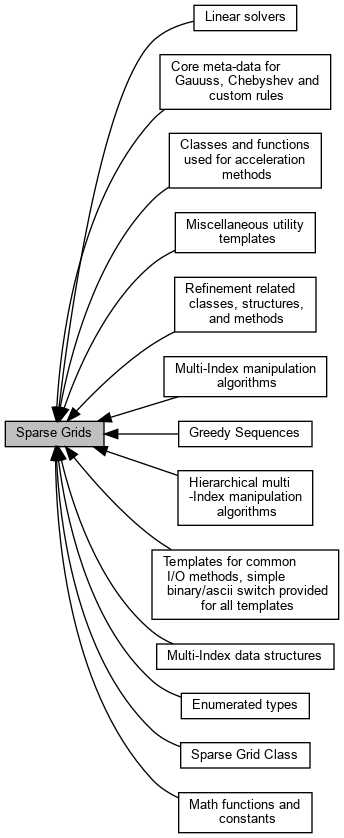
Files | |
| file | TasmanianSparseGrid.hpp |
| Main header for the Sparse Grid module. | |
Namespaces | |
| namespace | TasGrid |
| Encapsulates the Tasmanian Sparse Grid module. | |
Functions | |
| TasmanianSparseGrid | TasGrid::makeEmpty () |
| Returns an empty sparse grid. | |
| TasmanianSparseGrid | TasGrid::makeGlobalGrid (int dimensions, int outputs, int depth, TypeDepth type, TypeOneDRule rule, std::vector< int > const &anisotropic_weights=std::vector< int >(), double alpha=0.0, double beta=0.0, const char *custom_filename=nullptr, std::vector< int > const &level_limits=std::vector< int >()) |
| Factory method, creates a new grid and calls TasmanianSparseGrid::makeGlobalGrid(). | |
| TasmanianSparseGrid | TasGrid::makeSequenceGrid (int dimensions, int outputs, int depth, TypeDepth type, TypeOneDRule rule, std::vector< int > const &anisotropic_weights=std::vector< int >(), std::vector< int > const &level_limits=std::vector< int >()) |
| Factory method, creates a new grid and calls TasmanianSparseGrid::makeSequenceGrid(). | |
| TasmanianSparseGrid | TasGrid::makeLocalPolynomialGrid (int dimensions, int outputs, int depth, int order=1, TypeOneDRule rule=rule_localp, std::vector< int > const &level_limits=std::vector< int >()) |
| Factory method, creates a new grid and calls TasmanianSparseGrid::makeLocalPolynomialGrid(). | |
| TasmanianSparseGrid | TasGrid::makeWaveletGrid (int dimensions, int outputs, int depth, int order=1, std::vector< int > const &level_limits=std::vector< int >()) |
| Factory method, creates a new grid and calls TasmanianSparseGrid::makeWaveletGrid(). | |
| TasmanianSparseGrid | TasGrid::makeFourierGrid (int dimensions, int outputs, int depth, TypeDepth type, std::vector< int > const &anisotropic_weights=std::vector< int >(), std::vector< int > const &level_limits=std::vector< int >()) |
| Factory method, creates a new grid and calls TasmanianSparseGrid::makeFourierGrid(). | |
| TasmanianSparseGrid | TasGrid::readGrid (const char *filename) |
| Factory method, creates a new grid and calls TasmanianSparseGrid::read(). | |
| TasmanianSparseGrid | TasGrid::readGrid (std::string const &filename) |
| Overload using std::string. | |
| TasmanianSparseGrid | TasGrid::copyGrid (TasmanianSparseGrid const &source, int outputs_begin=0, int outputs_end=-1) |
| Returns a grid that is a copy of the source. | |
Variables | |
| constexpr bool | TasGrid::mode_ascii = false |
| Constant allowing for more expressive selection of ascii and binary mode in IO methods. | |
| constexpr bool | TasGrid::mode_binary = true |
| Constant allowing for more expressive selection of ascii and binary mode in IO methods. | |
|
inline |
Returns an empty sparse grid.
Usage:
Useful for some MPI calls where some MPI ranks must pass a dummy empty grid.
|
inline |
Factory method, creates a new grid and calls TasmanianSparseGrid::makeGlobalGrid().
Allows for one-line initialization, i.e.,
as opposed to
|
inline |
Factory method, creates a new grid and calls TasmanianSparseGrid::makeSequenceGrid().
Allows for one-line initialization, see TasGrid::makeGlobalGrid().
|
inline |
Factory method, creates a new grid and calls TasmanianSparseGrid::makeLocalPolynomialGrid().
Allows for one-line initialization, see TasGrid::makeGlobalGrid().
|
inline |
Factory method, creates a new grid and calls TasmanianSparseGrid::makeWaveletGrid().
Allows for one-line initialization, see TasGrid::makeGlobalGrid().
|
inline |
Factory method, creates a new grid and calls TasmanianSparseGrid::makeFourierGrid().
Allows for one-line initialization, see TasGrid::makeGlobalGrid().
|
inline |
Factory method, creates a new grid and calls TasmanianSparseGrid::read().
Allows for one-line initialization, makes a new grid and reads from a file.
| filename | same as TasmanianSparseGrid::read(). |
|
inline |
Overload using std::string.
Same as readGrid() but the filename is given as a string.
|
inline |
Returns a grid that is a copy of the source.
Creates a new grid and calls TasmanianSparseGrid::copyGrid() from the source.
| source | is the grid to copy from. |
| outputs_begin | same as TasmanianSparseGrid::copyGrid(). |
| outputs_end | same as TasmanianSparseGrid::copyGrid(). |