

Bayesian Inference#
Reno provides a mechanism for taking a model with multiple probability distributions and running Bayesian inference based on one or more observed values in the system in order to produce posterior probability distributions.
This is done through the PyMC library - since math equations in Reno have the ability to produce a PyTensor equivalent, Reno can recreate the entire system dynamics model as a PyMC model along with the mechanisms to compute the full timeseries outputs, and then take advantage of PyMC’s samplers to approximate posteriors.
The value of doing this through Reno as opposed to directly through PyMC comes from a few observations:
Setting up timeseries evaluation in pytensor involves significant boilerplate that can be confusing to learn.
The order in which equations are executed during evaluation matters to avoid circular dependency issues or incorrect calculations. Reno handles dependency ordering itself when converting into PyTensor.
Re-parameterizing or modifying equations involves changing the boilerplate or redefining the model. Reno rebuilds the PyMC model every time, addressing this automatically.
Running a Reno model with PyMC involves calling the model’s .pymc() function. This function acts similarly to the default
__call__(), optionally taking any free
variable/initial value conditions, plus some pymc-specific sampling arguments.
A simple prior-only “forward run” of the model in PyMC (running the simulations
based solely on prior probabilities) is done by passing compute_prior_only=True
to the pymc function:
import reno as r

t = r.TimeRef()
tub = r.Model("tub", steps=30, doc="Model the amount of water in a bathtub based on a drain and faucet rate")
with tub:
    faucet, drain = r.Flow(), r.Flow()
    water_level = r.Stock()

    faucet_off_time = r.Variable(5, doc="Timestep to turn the faucet off in the simulation.")

    faucet >> water_level >> drain

    # the faucet should be some waterflow amount until the faucet is turned
    # off, so we use a piecewise operation to make a conditional based on time
    faucet.eq = r.Piecewise([5, 0], [t < faucet_off_time, t >= faucet_off_time])

    drain.eq = r.sin(t) + 2
    # the drain can't move negative water, and can't drain more than exists
    # in the tub
    drain.min = 0
    drain.max = water_level

    final_water_level = r.Metric(water_level.timeseries[-1])
trace = tub.pymc(n=1000, faucet_off_time=r.Normal(10, 5), compute_prior_only=True)
.pymc calls return Arviz InferenceData objects, which contain a
.prior XArray dataset (very similar to what the normal Reno model call
returns) and when not passing compute_prior_only=True a .posterior
XArray dataset as well.
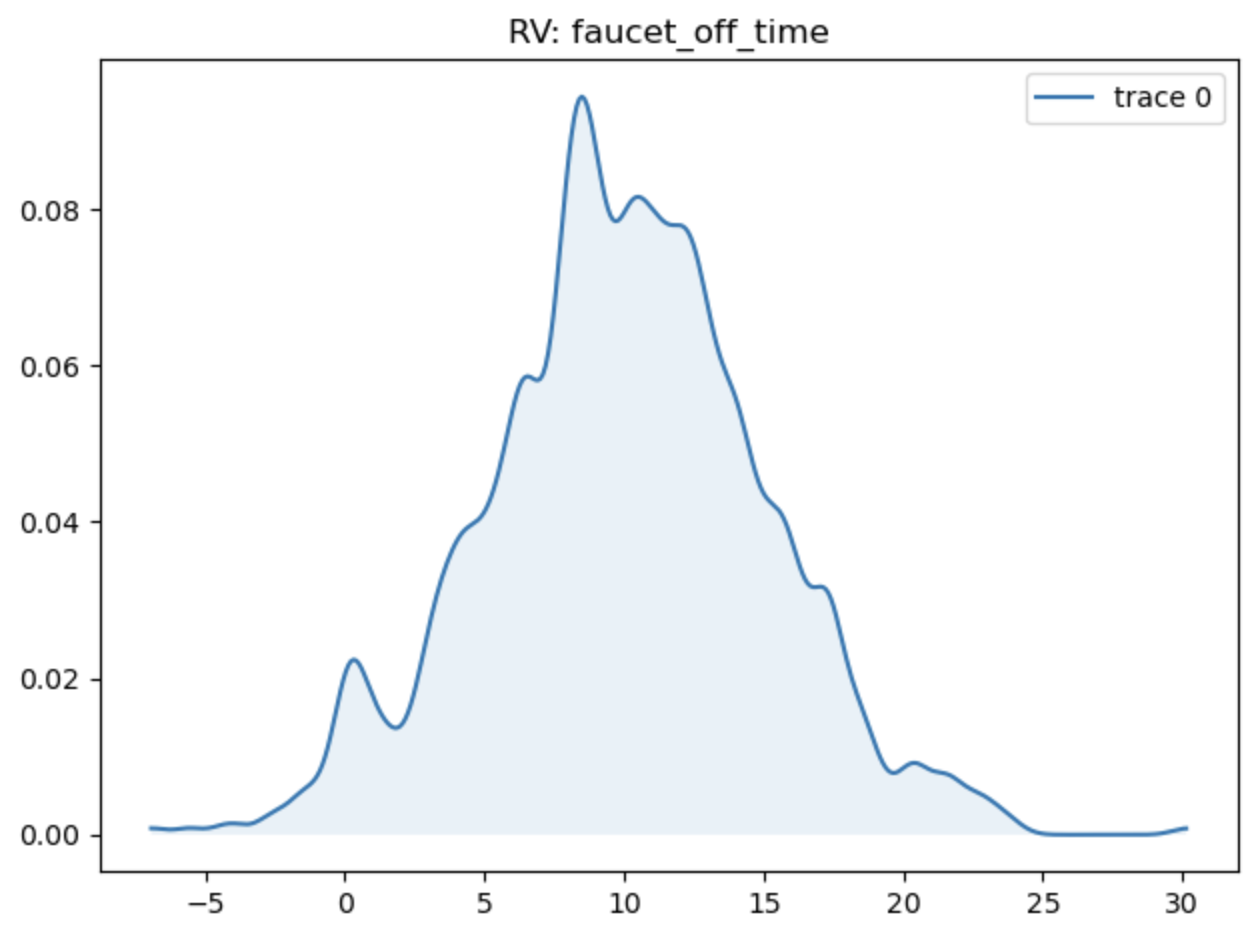
We can confirm the normal distribution on the variable by plotting it from the trace:
r.plot_trace_refs(tub, [trace.prior], [tub.faucet_off_time])
Bayesian inference comes in when we know some additional piece of data or have
an observed value for a metric somewhere, and want to determine how the
probability distributions change to produce that observed value. These are
provided to the .pymc call through the observations argument, which
takes a list of reno.ops.Observation instances. These effectively
define a normal likelihood function around a metric, with specified observed
mean and standard deviation.
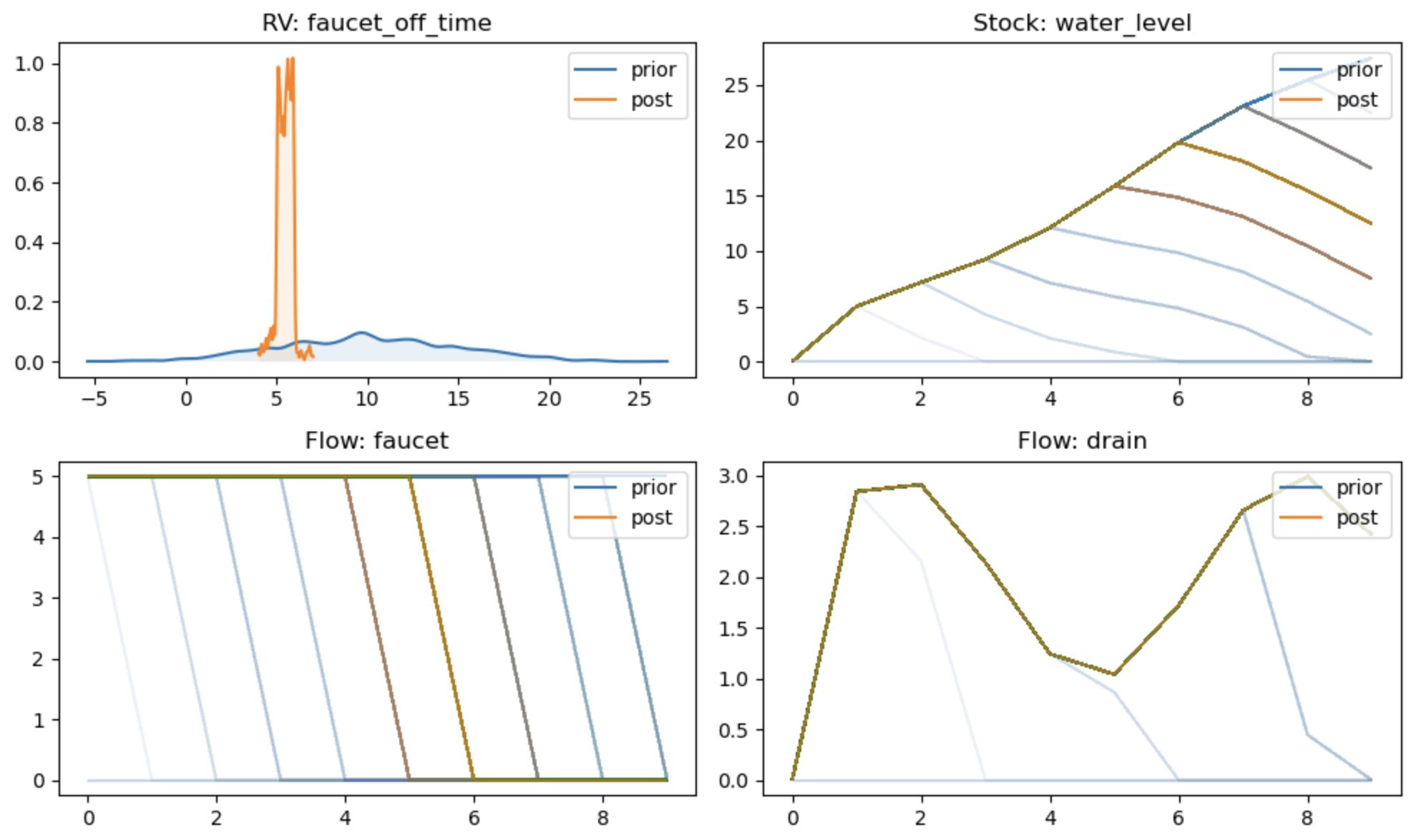
As an example, suppose we observed that the final level in the tub was 12, with
some allowance for uncertainty, and we want to find out what the likely cut off
time for the faucet was. We run the .pymc function with an observation on
the final_water_level metric:
trace = tub.pymc(
    n=1000,
    faucet_off_time=r.Normal(10, 5),
    observations=[r.Observation(tub.final_water_level, [12.0], 2.0)]
)
And observe the change from prior to posterior:
r.plot_trace_refs(
    tub,
    {"prior": trace.prior, "post": trace.posterior},
    [tub.faucet_off_time, tub.faucet, tub.drain, tub.water_level],
    figsize=(10, 6)
)
Implied metrics#
Observations are typically given a reno.components.Metric
component in the model, which their provided value describes. An observation can
also be given a direct equation part, which is implicitly turned into a new
metric, for example:
tub.final_water_level = r.Metric(tub.water_level.timeseries[-1])
tub.pymc(
    ...
    observations = [r.Observation(tub.final_water_level, ...)]
)
Could instead implicitly get the final water level equation with:
tub.pymc(
    ...
    observations = [r.Observation(tub.water_level.timeseries[-1], ...)]
)
This can be useful in cases where you might have observations for several different timesteps, and it’s too cumbersome to create individual metric components for every single one.
Observations and config via data#
The .pymc function has a data parameter, which can be used as an
alternative to observations. Passing a dictionary of references
and/or equation parts will populate free variables
(configuration) as well as observed values, in a way that’s more convenient if you
have a dataset in a pandas dataframe. Take the following model,
which simply defines a linear function parameterized by an intercept and slope:
m = r.Model()
with m:
    intercept = r.Variable(r.Uniform(0.0, 10.0))
    slope = r.Variable(r.Uniform(1.0, 6.0))
    value = r.Stock(init=intercept)
    value += slope

    final = r.Metric(value.timeseries[-1])
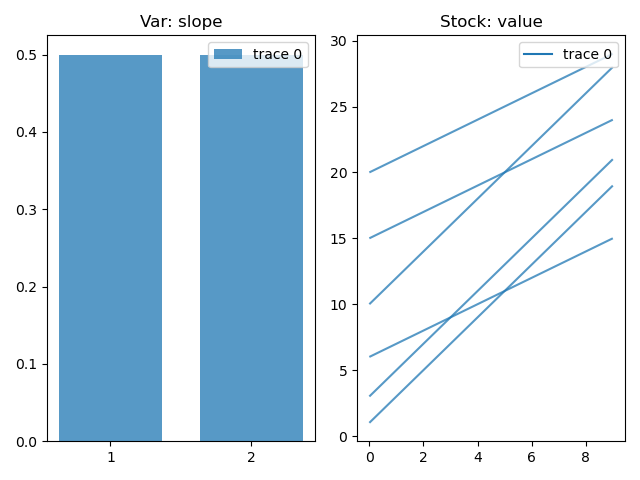
We could run this model with “multiple rows of data”, or several intercepts and slopes, to get a variety of stock lines:
example_data_trace = m(
    n=6,
    intercept=r.List([1, 10, 3.5, 15, 20, 6]),
    slope=r.List([2, 2, 2, 1, 1, 1])
)
r.plot_trace_refs(m, [example_data_trace], [m.slope, m.value])
From a Bayesian inference standpoint, we’ll assume we don’t know what the slopes are, but have the final measurement values for each of those slope/intercept pairs. We could pass this final measurement as a list to the observation:
m.pymc(
    n=4000,
    intercept=[1, 10, 3.5, 15, 20, 6],
    slope=r.Uniform(0.0, 6.0, dim=6),
    observations=[
        r.Observation(m.final, [19.0, 28.0, 21.0, 24.0, 29.0, 15.0], 0.5)
    ],
)
Alternatively, if we had all of our data in a dataframe, we can pass one or both of
m.intercept and m.final as keys in the data dictionary. Note that
distributions can be passed directly, rather than indirectly setting the
arguments on an observation.
import pandas as pd

df = pd.DataFrame({
    "intercept": [1, 10, 3.5, 15, 20, 6],
    "final": [19.0, 28.0, 21.0, 24.0, 29.0, 15.0],
})

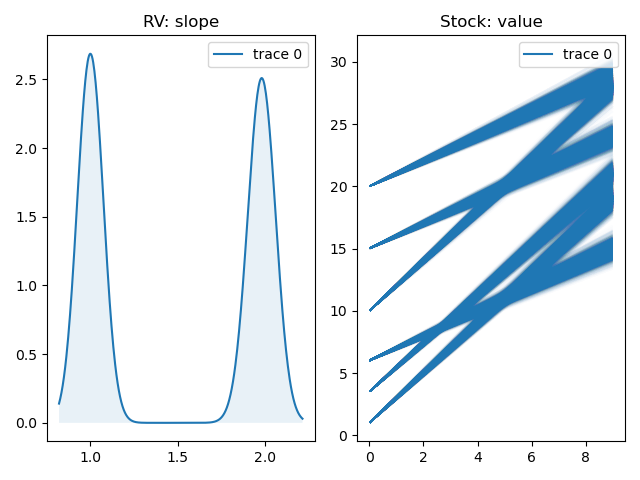
trace = m.pymc(
    n=4000,
    slope=r.Uniform(0.0, 6.0, dim=len(df)),

    data = {
        m.intercept: df.intercept,
        m.final: r.Normal(df.final, 0.5),
    }
)
r.plot_trace_refs(m, [trace], [m.slope, m.value])
To extend the example further, we could assume we have different uncertainty
values for each example in each row, and pass those in through distributions in
data as well:
df = pd.DataFrame({
    "intercept": [1, 10, 3.5, 15, 20, 6],
    "intercept_unc": [1.0, 0.5, 0.2, 0.5, 0.1, 0.2],
    "final": [19.0, 28.0, 21.0, 24.0, 29.0, 15.0],
    "final_unc": [0.1, 1.0, 0.2, 0.2, 0.1, 0.5],
})

trace = m.pymc(
    n=4000,
    slope=r.Uniform(0.0, 6.0, dim=len(df)),

    data = {
        m.intercept: r.Normal(df.intercept, df.intercept_unc),
        m.final: r.Normal(df.final, df.final_unc),
    }
)
r.plot_trace_refs(m, [trace], [m.slope, m.value])
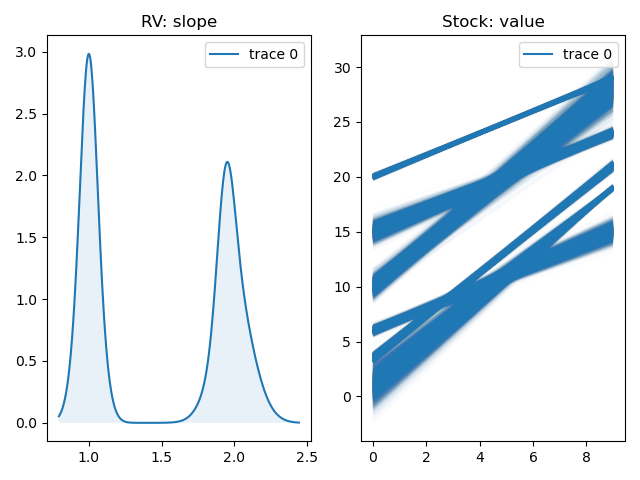
Fundamentally this allows a more intuitive/semantic way of using collections of measurement data which may be describing a combination of system “inputs” (free variables) and “outputs” (observations).
Technical process#
Under the hood, Reno produces a PyMC model by defining the following:
A PyMC variable per component set to the initial conditions/values of that component. (When no separate
initis provided for a component, this is just the equation itself run at timestep 0)The full timeseries sequences for each component are iterated/produced using PyTensor’s scan function, inside of which runs the difference equation for every component (produced recursively through
EquationPart’s.pt())Initial conditions and timeseries sequences are combined, and any metric equations are defined as additional PyMC deterministics.
Reno adds any likelihood functions for provided observations, using normal distributions around the specified metric.
Some of the details and code samples for what this looks like can be found in the
reno.pymc module.
Transpiling#
In addition to directly producing a PyMC model, Reno models can also transpile into a raw string of python code that creates the equivalent PyMC model. If you need to run a more complex bayesian problem than a Reno model provides (e.g. more complicated/custom likelihood functions, performance optimizations that require manual adjustment, or using the Reno model in some larger overarching model), then Reno can be used as a starting point for writing the code (and takes care of a lot of the complexity around using the scan function.) It can also be helpful for debugging issues in a PyMC model. If you’ve implemented a custom Reno operation (Custom operations) and a pytensor conversion isn’t working correctly, minor changes to the PyMC code might be tested more quickly than modifying the Reno operation code first.
For example, the transpiled code from the model above produced by running
print(tub.pymc_str()) (see function documentation for
reno.model.Model.pymc_str()):
def tub_step(*args):
    t = args[0]
    water_level = args[1]
    faucet = args[2]
    drain = args[3]
    faucet_off_time = args[4]

    # Difference/recurrence equations
    water_level_next = (water_level + (faucet - drain))
    drain_next = pt.maximum(pt.minimum((pt.sin(t) + pt.as_tensor(2)), water_level_next), pt.as_tensor(0))
    faucet_next = pt.switch((t < faucet_off_time), pt.as_tensor(5), pt.as_tensor(0))

    # Type checks
    water_level_next = water_level_next.astype(water_level.dtype) if water_level_next.dtype != water_level.dtype else water_level_next
    drain_next = drain_next.astype(drain.dtype) if drain_next.dtype != drain.dtype else drain_next
    faucet_next = faucet_next.astype(faucet.dtype) if faucet_next.dtype != faucet.dtype else faucet_next

    return [water_level_next, faucet_next, drain_next], pm.pytensorf.collect_default_updates(inputs=args, outputs=[water_level_next, faucet_next, drain_next])

coords = {
    "t": range(10),
}
with pm.Model(coords=coords) as tub_pymc_m:
    # Initial values/timestep 0 equations
    water_level_init = pm.Deterministic("water_level_init", pt.as_tensor(np.array(0.0)))
    drain_init = pm.Deterministic("drain_init", pt.maximum(pt.minimum((pt.sin(pt.as_tensor(0)) + pt.as_tensor(2)), water_level_init), pt.as_tensor(0)))
    faucet_off_time = pm.Deterministic("faucet_off_time", pt.as_tensor(5))
    faucet_init = pm.Deterministic("faucet_init", pt.switch((pt.as_tensor(0) < faucet_off_time), pt.as_tensor(5), pt.as_tensor(0)))
    timestep_seq = pt.as_tensor(np.arange(1, 10))

    # Run autoregressive step function/timestep-wise updates to fill sequences
    [water_level_seq, faucet_seq, drain_seq], updates = pytensor.scan(
        fn=tub_step,
        sequences=[timestep_seq],
        non_sequences=[faucet_off_time],
        outputs_info=[water_level_init, faucet_init, drain_init],
        strict=True,
        n_steps=9
    )

    # Collect full sequence data for all stocks/flows/vars into pymc variables
    water_level = pm.Deterministic("water_level", pt.concatenate([pt.as_tensor([water_level_init]), water_level_seq]), dims="t")
    faucet = pm.Deterministic("faucet", pt.concatenate([pt.as_tensor([faucet_init]), faucet_seq]), dims="t")
    drain = pm.Deterministic("drain", pt.concatenate([pt.as_tensor([drain_init]), drain_seq]), dims="t")
    final_water_level = pm.Deterministic("final_water_level", water_level[pt.as_tensor(-1)])
Note that the output from pymc_str assumes certain imports already exist
(e.g. pymc and pytensor), these assumptions can also be retrieved as a string
using reno.pymc.pymc_model_imports():
>>> print(reno.pymc.pymc_model_imports())
import pytensor
import pytensor.tensor as pt
import pymc as pm
import numpy as np